THIS
POST WAS ORIGINALLY PUBLISHED APRIL 27, 2011
Iron Ore Miners – Can We Get Financing? - with Update
Today
iron ore seems to be an extremely hot commodity – that is a big demand.
Hundreds of documents are produced daily that describe various aspects
of this ore – everything associated with it. In my shot post I would
like to give an update on the most burning issue for miners – can we get
money to fund our iron ore project? At the first glance, it seems that –
without any doubts – lots of investors are willing to invest. However,
there are lots of projects that are very sound itself, but here come a
substantial intricacy in conveying our message to investor.
In my Blog
earlier I touched a number of issues, associated with the work that
miners should do to prepare the company for sale/investment:
Want to Sell a Mining Property? - CONSULTANTS' ROLES
Want to Sell a Mining Property? Due Diligence
Mining Companies: Where to Get Money?
Mining Companies: Where to Get Money? - An Eyeball on Investors
Mining Companies: Where to Get Money? - Investor Presentation
Deloitte: Develop a New Mining Strategy
Seeking Alpha on Iron Ore Basics

There
are a lot of materials that are helpful in preparation for investor
discussions. An extremely interesting document that has a lot of advice
was recently released by The Boston Consulting Group:
Value Creation in Mining Companies . That is a very cognitive reading material for mining professionals (in particular the “Value Creating Questions for Mining Executives”). I would however, pinpoint one of the suggestions for the Junior Mining companies: “COMPANIES THAT DEVELOP THE INTELLIGENCE AND AGILITY TO PLAY IN THE JUNIOR MARKET WILL GAIN A CLEAR EDGE”.
Indeed, intelligence and agility – these are the sources for success. Talking about intelligence – what is the picture with iron ore?
Back in August
2010 International Business Times stated: most investors in this sector
are ignoring a more important medium term trend, the looming oversupply
of iron ore as new mines and expansions come on stream. (Iron Ore: Watch The Emerging Glut).
Here is also a well-known graph form McKinsey:

Today, we have this news:
SHANGHAI,
April 27 (Reuters) - Global supply and demand conditions for iron ore
may reverse sooner than expected after a years-long investment frenzy,
the chief of China's leading steelmaker said. "In the last decade, iron
ore has turned into a crazy stone from an ordinary stone," Baosteel
Group chairman Xu Lejiang was quoted as saying by the Shanghai
Securities News. The current cycle was coming to an end and massive
investment over the past 10 years would soon translate into an iron ore
supply surge, said Xu. (China's Baosteel warns of end to iron ore investment frenzy – paper)
The more gloomy picture comes here:
“Iron
ore reserves at present seem quite vast, but some are starting to
suggest that the maths of continual exponential increase in consumption
can even make this resource seem quite finite. For instance, Lester
Brown of the Worldwatch Institute has suggested iron ore could run out within 64 years based on an extremely conservative extrapolation of 2% growth per year.”
Indeed, there is a lot of discussions recently on new areas for iron ore mining:
For
instance iron ore mines, that are now increasing production and new
opening in all four countries; LKAB in Gällivare-Kiruna increase the
production, Sydvaranger in Kirkenes has re-opened an old mine, Northland
mining company are opening new mines in the Swedish-Finnish border
areas around Kolari and Pajala, while Russia’s Severstal invests in the
iron-ore mines in Olenogorsk.
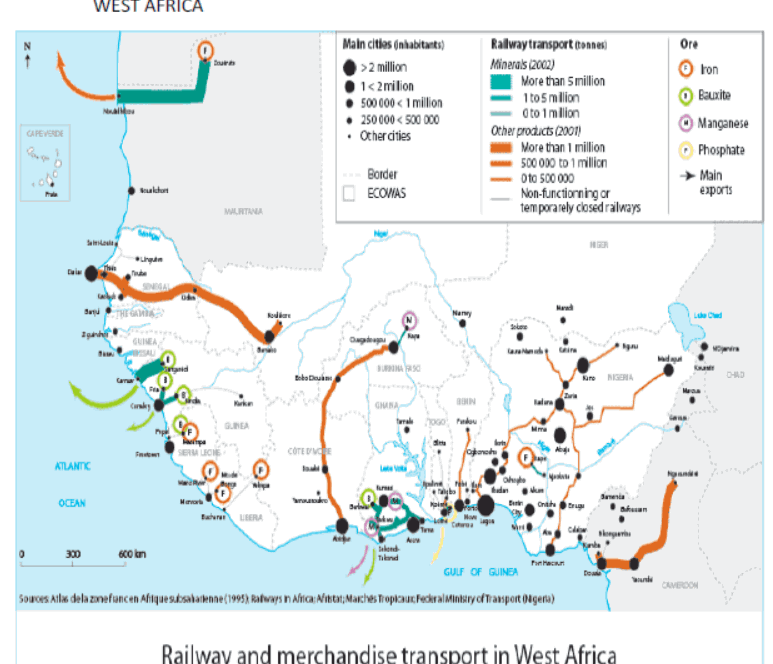
An interesting discussion is proposed in this piece by The International Resource Journal: Are we on the way to Pilbara Two in West Africa?. This is rather speculative announcement regarding Rio Tinto : “moves
were made to suggest that majors in the nation’s iron ore province
could be considering shipping out to look for more favourable ground,
and West Africa appeared to be the destination up for discussion.”
By RBC Capital
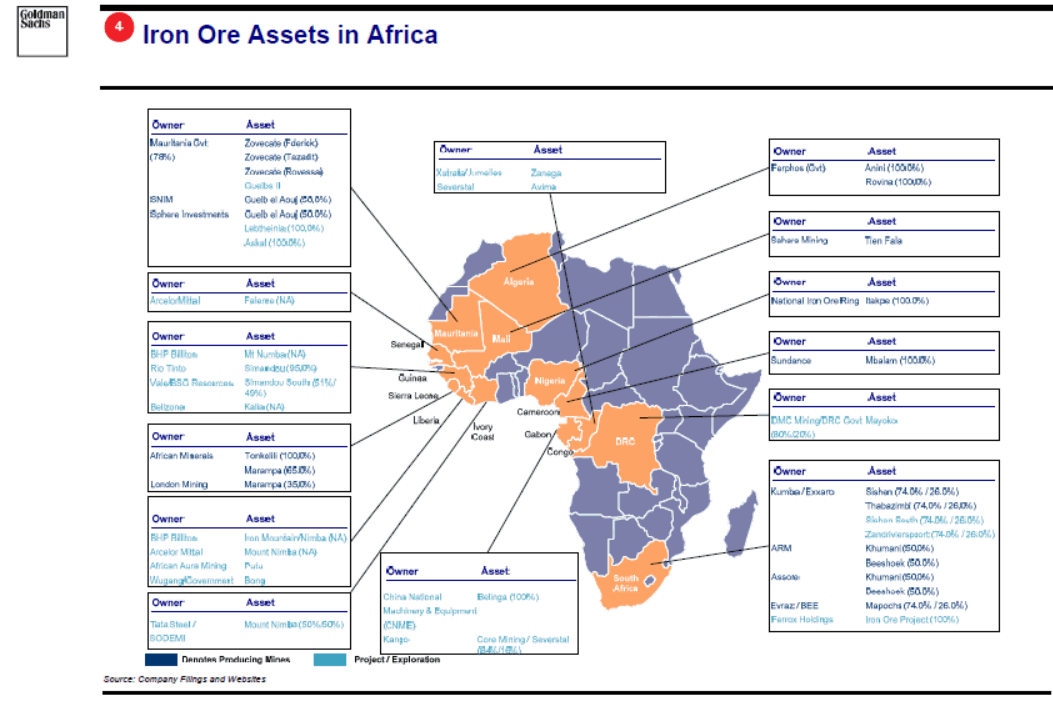
Markets’ calculations, planned African projects total at least 500
Mt/y, at an all-in capital cost of over $50 billion over the next eight
years. (African iron ore projects: potential for new supply).
And other exciting comparison: that concerns Africa and Artic Circle deposit:
"London-based
Rio Tinto (NYSE: RIO) claims that the Simandou deposit in the West
African country of Guinea – which it controls with a 53% stake – is the
largest iron ore deposit in the world. Reserve estimates for Simandou,
however, are only 2.25 billion tons, which is less than Baffinland’s
4-billion-ton-potential but more than Baffinland’s “official” estimate
of 854 million tons."
For those, interested to invest in iron ore mining companies, a good example is presented by MoneyWeb: The Investment Case - Kumba Iron Ore. “As
a focused, iron ore-mining business, Kumba has benefited from the more
than five-fold increase in the price of this resource over the last ten
years” – with detailed structure of investments.
Top Metal: Iron Trumps Copper - this is the item of the ANNUAL SURVEY OF GLOBAL MINING INVESTMENT that is published in the latest ASIA Miner March/April 2011 issue
“Iron
ore investment has surpassed that of copper with a project pipeline of
$162 billion—compared with $155 million for copper— while gold and
nickel are at much lower levels ($83 billion and $69 billion,
respectively) distantly followed by the sector, valued at $15–$20
billion, in which uranium, lead/zinc and PGMs are to be found.

Iron
ore outpaced the other metals in terms of new investment, registering
an increase to $28 billion. New gold project investment totaled $7
billion and copper to just under $6 billion in 2010.
The
average iron ore project investment was almost $1.3 billion, up from
$750 million, while the average gold project has remained steady at $204
million. Ir on ore’s share of total new investment announced in 2010
increased again after a decline in 2009, reaching 47%. The continuing
demand growth for steel and the concomitant high prices paid for iron
ore point to a strong increase in iron ore production in the next three
to five years.”
And some more news URLs:
- African iron ore glows
- BHP to spend $9,5bn on Australian iron-ore and coal expansions
- Rio Tinto in $1 bn iron ore investments in Australia, Canada
- Strike while the iron is hot - and overview of iron ore mining companies
And finalizing my brief overview: Is iron ore the new gold? – that was the question that was raised by one of the investor consulting Website.
“There
are several ways to play iron ore. One is to invest in a global metals
exchange traded fund. The other is to invest in the big three iron ore
producers listed above individually (the three collectively control over
65% of the market) or the third, for those with the stomach to do it,
is to invest in junior iron ore companies- big upside, big risk…”
Thus, to be or not to be? Can iron ore miners get funds for their projects? Or this is too risky ?
Think about intelligence and agility
UPDATE:
UPDATE:

"How
long until the window on rising iron-ore prices closes? Global demand
is driving prices higher and shipping costs are at historic lows. But
only companies poised to get into production quickly will be able to
capitalize."
This is from just published interview Geordie Mark: Global Demand for Iron Ore on Rise 


 West Africa Gold: ASX-listed gold company valuations